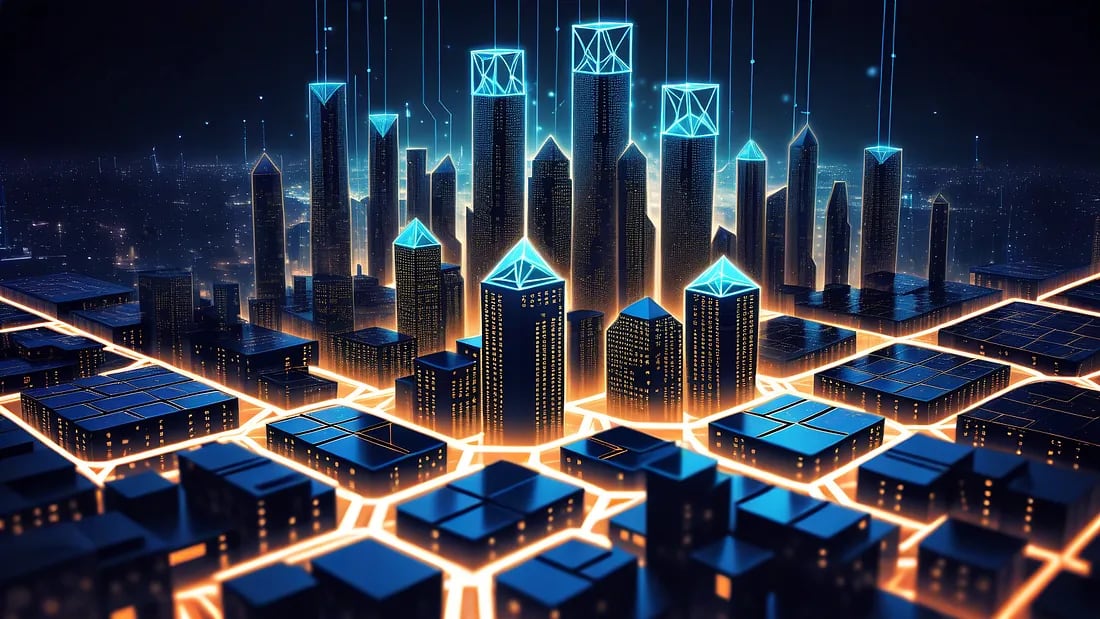

Five years ago, I wrote a Forbes article about the digital revolution that is currently transforming the real estate industry — now I’ll bring you up to speed on how blockchain technology continues to bring about cutting-edge innovation and immense opportunity in the property business as of June 2025, be it buying, selling, investing and owning, the latest key information you need to know now, and the biggest ‘happenings’ occurring in 2025 regarding how the 4-trillion dollar real estate industry is evolving via blockchain technology through the emerging multi-billion dollar market for tokenized real estate assets, US cities adopting property title recording on the blockchain (from Chicago to Dubai) and many other fascinating ways that blockchain technology is pushing the advancement of the real estate industry to new heights.
My goal here is to provide you with fresh marketplace intelligence and to inspire you to view the real estate industry in a new and different light, where digital innovation is driving new, more efficient ways of transacting, new and more accessible means of investing and new technologies to study so that you are ahead of the curve.
The State of the Real Estate Blockchain Industry in June 2025
(Comprehensive Update with current 2025 Data, Use Cases, and Key Players)
Executive Summary
As of June 2025, real estate tokenization has transitioned from experimental trials to a $10–$15 billion tokenized asset market globally, with $500 billion in cumulative investments since 2020. While smaller than earlier bullish projections, the industry is growing rapidly, driven by Dubai’s government-led tokenized property deeds, JPMorgan’s cross-chain RWA experiments, and Retail investor adoption via platforms like RealT and Lofty. The U.S. remains the leader, hosting 60% of global tokenized properties (residential, commercial, and infrastructure), followed by Europe (25%) and Asia (10%). Institutional interest is rising, with pension funds allocating 2–5% of portfolios to tokenized assets, but regulatory uncertainty and technical scalability are still limiting mass adoption.
How Real Estate Tokenization Works (Updated Process)
Tokenization converts physical properties into blockchain-based digital tokens representing fractional ownership. The process now follows standardized steps:
Establish a legal entity (e.g., LLC) to own the property. Consult legal experts to comply with securities laws (e.g., SEC regulations in the U.S.) and determine whether tokens qualify as securities. Draft agreements outlining investor rights, profit-sharing, and governance.
Appraise the property to determine its fair market value — independent auditors assess the property value. The global average tokenized asset value is $10 million, with outliers like Red Swan’s $100 million luxury hotel in Dubai. Decide the number of tokens to issue (e.g., 10,000 tokens representing fractional ownership) and define their attributes: fungibility (ERC-20), non-fungibility (NFT via ERC-721), or hybrid models (ERC-1155).
Choose a blockchain (e.g., Ethereum, Binance Smart Chain, Solana, or Polkadot) based on transaction costs, scalability, and compliance support. For security tokens, platforms with regulatory frameworks (e.g., Polymath) may be necessary.
Create smart contracts to govern token issuance, ownership transfers, revenue distribution (e.g., rental income), and voting rights. Ensure contracts are audited for security and functionality.
Set up a compliant token sale platform. Market the opportunity via whitepapers, investor presentations, and KYC/AML verification processes. Determine pricing, sale duration, and minimum/maximum investment thresholds.
Upon successful sale, distribute tokens to investors’ wallets. Use raised funds to acquire the property. Record ownership on the blockchain via token balances.
Operate the property (leasing, maintenance) through a manager or decentralized autonomous organization (DAO). Automate revenue distribution via smart contracts, allocating profits to token holders.
List tokens on regulated or decentralized exchanges (e.g., tZero, OpenEden) to enable trading post-sale. This provides investors with exit/entry flexibility.
Residential property tokenization: Allowing fractional ownership of residential properties, making investment more accessible.
Commercial real estate tokenization: Tokenizing properties like office buildings and hotels, enabling fractional ownership and potential income through rental distributions.
Real Estate Investment Trusts (REITs): Digitizing REIT shares on the Solana blockchain.
Examples:
· Homebase: A platform built on Solana that allows users to invest in fractional ownership of residential properties through NFTs. Homebase successfully tokenized a $235,000 property, raising funds from multiple investors.
· MetaWealth: A platform specializing in tokenizing high-value real estate properties into accessible digital investments on Solana.
· Parcl: A decentralized real estate trading platform on Solana that offers synthetic exposure to global real estate market price movements.
The typical tokenization of a $10M property might split into 10,000 tokens at $1,000 each. 6
Key Benefits of Tokenization as of 2025
Tokenized assets trade 24/7, eliminating the “illiquidity discount.” For example, Dubai’s tokenized land sales achieved 15% higher valuations by attracting international buyers. 4
Platforms like Lofty and Meridio enable investments as low as $100, democratizing access to commercial real estate. Reental’s $57 million portfolio spans 82 properties, with average tickets of $500–$1,500. 2
The U.S. leads with 970+ tokenized properties (e.g., Detroit rentals via RealT). In 2025, 85% of tokenized assets are commercial or industrial, while residential adoption lags due to complexities in title transfers, lending, and insurance. 9
Blockchain’s immutability dramatically reduces fraud. Propy’s Dubai hotel sale and Harbor’s U.S. industrial tokenization projects use on-chain verification for ownership and compliance. 10
Smart contracts slash transaction costs by 50–70% (HSBC 2024 report) and settlement times from 45 days to under 24 hours. Dubai’s 2025 reforms reduced deed registration costs by 80%. 4
Tokenized assets like DAMAC Properties’ Dubai luxury project attract buyers from 50+ countries, bypassing currency conversion via stablecoins (USDC, DAI). 5
Tokens can embed rules for dividends, voting rights, or yield redistribution. SolidBlock’s $500 million tokenized portfolio uses programmable contracts for automatic tax compliance. 2
Market Size and Regional Trends
Global Tokenized Real Estate Market:
U.S. Tokenized Real Estate Market:
Residential Real Estate Tokenization:
Tokenized Property Locations:
Major Players and Use Cases in 2025
Tokenization Platforms:
Infrastructure Providers:
Institutional and Government Initiatives:
Top 10 Tokenization Companies (as of June 2025):
Regulatory Environment in 2025
Challenges and Limitations
The Future of Real Estate Tokenization (2030–2035)
My Perspective: Why Tokenization Matters (Garratt Hasenstab, Resource Blockchain)
As a veteran blockchain real estate and tokenization advisor and Forbes contributor, I focus on three pillars of excellence in the real world asset tokenization space:
https://www.forbes.com/councils/forbestechcouncil/2023/09/15/the-reawakening-of-real-estate-tokenization-why-businesses-should-take-note
https://www.forbes.com/sites/forbesrealestatecouncil/2019/11/13/the-future-of-real-estate-investing-digital-assets-are-here-now
https://www.forbes.com/sites/forbesrealestatecouncil/2020/04/27/the-transformation-of-an-industry-blockchain-based-real-estate-assets
Outlook: From Niche to Mainstream?
Tokenized real estate is still in its early growth stage, with only 0.003% of the $300 trillion global real estate asset market tokenized. 3 However, the U.S. leads with 1,200+ properties on-chain, and Dubai’s 2025 reforms signal that governments are recognizing blockchain’s incredible potential. While residential tokenization remains underserved, platforms like Lofty and Propy are pioneering borderless property ownership for retail investors.
The numbers are still coming in, but Roland Berger clocked tokenized assets at $120 billion in 2023, while Deloitte said it’s still under $300 billion as of 2024. No one’s arguing about the future, though. BCG expects a 49% annual growth spurt, blowing up to $3.2 trillion by 2030. Others aren’t far behind, eyeing $3 trillion by the same year (roughly 15% of global real estate AUM). Deloitte stretches further, calling for $4 trillion worth of tokenized real estate assets by 2035 in their base case. Even if tokenization only grabs 5% of the $300+ trillion global real estate market, that’s still a seismic shift from today’s pocket-change scale. Bulls, bears, and fence-sitters all agree — this isn’t a niche play anymore.
Please feel free to reach out to me with any questions or comments!
All the best,
Garratt
Garratt Hasenstab is a real estate developer, digital asset investor and Senior Strategic Advisor with Resource Blockchain, a global advisory firm specializing in blockchain technology, tokenomics, smart contract development and asset tokenization for real estate owners, developers and investors, and he is a Regional Chair with the Foundation for International Blockchain and Real Estate Expertise (FIBREE). Follow his insights in Forbes and on ResourceBlockchain.io. Learn more about Garratt at: https://linktr.ee/garratt
Sources:
1 Forbes 2023 Tokenization Report
2 Deloitte 2024 Market Analysis
3 Roland Berger 2023 Tokenization Study
4 Dubai Land Department
5 Red Swan Tokenization Data
6 RealT Platform Metrics
7 Lofty’s Tokenization Model
8 tZERO Exchange Activity
9 HSBC Blockchain Pilot
10 Propy Dubai Sale
11 X (Twitter) RWA Forecasts
12 iFinex and Bit宅鋪
13 JPMorgan and Chainlink Partnership
14 SAG IPL Tokenization
15 Mantra Token Service (MTS)
Important disclaimers:
1. Not Financial Advice: The information provided above is for informational purposes only and should not be considered financial, investment, or trading advice.
2. Do Your Own Research (DYOR): Readers are encouraged to conduct their own independent research before making any investment decisions.
3. Consult with a Financial Advisor: It is recommended to seek advice from a qualified financial advisor who can assess your individual circumstances and investment goals.
Pertinent hashtags:
#Blockchain #RealEstate #BlockchainRealEstate #Tokenization #RealEstateTokenization #TokenizedAssets #SmartContracts #DeFi #REIT #TokenizedProperty #FractionalOwnership #ResourceBlockchain #Web3RealEstate #Web3 #DistributedLedger #DLT #RealEstateIndustry #Investing #CryptoInvesting #CommercialRealEstate #ResidentialRealEstate #FIBREE #RealEstateInvestment #DecentralizedProperty #RegulatoryCompliance #DigitalLandRegistry #Cryptocurrency #Fintech #DeFiRealEstate #Base #Polygon #Bitcoin #Ethereum #Solana
For Sale: Stunning New Construction Luxury Home in Silverthorne, Colorado